

Do you want to get more out of your team and develop its full potential?
Then get started with team development in a customized Team Pathway using the EXCEL method!
In 6 months, your team develops to high performance with our proven methodology.
Short, powerful workshops to get to know each other better
Content, energy and (inter-)action in every team building activity
Organizable anywhere and accessible to everyone

Teamontwikkeling doen we in een Team Traject. Dit houdt in dat je samen gaat werken IN en AAN het team. Traject betekent letterlijk: ‘af te leggen route’. Dat is waar het met je team om draait.
Jullie gaan samen op pad en onderweg van elkaar en over elkaar leren. Zie het maar als een avontuurlijke expeditie waarbij de route en/of eindbestemming niet van te voren vast ligt. De reis is hierbij belangrijker dan de bestemming.
Op gezette momenten zal worden stilgestaan, om terug te blikken en vooruit te kijken. Teamontwikkeling is een cyclisch proces dat bestaat uit verschillende fases die tijd nodig hebben.
Een team is een levend systeem en iedere verandering zorgt voor invloed. Dit vraagt om natuurlijk leiderschap en organisch organiseren.
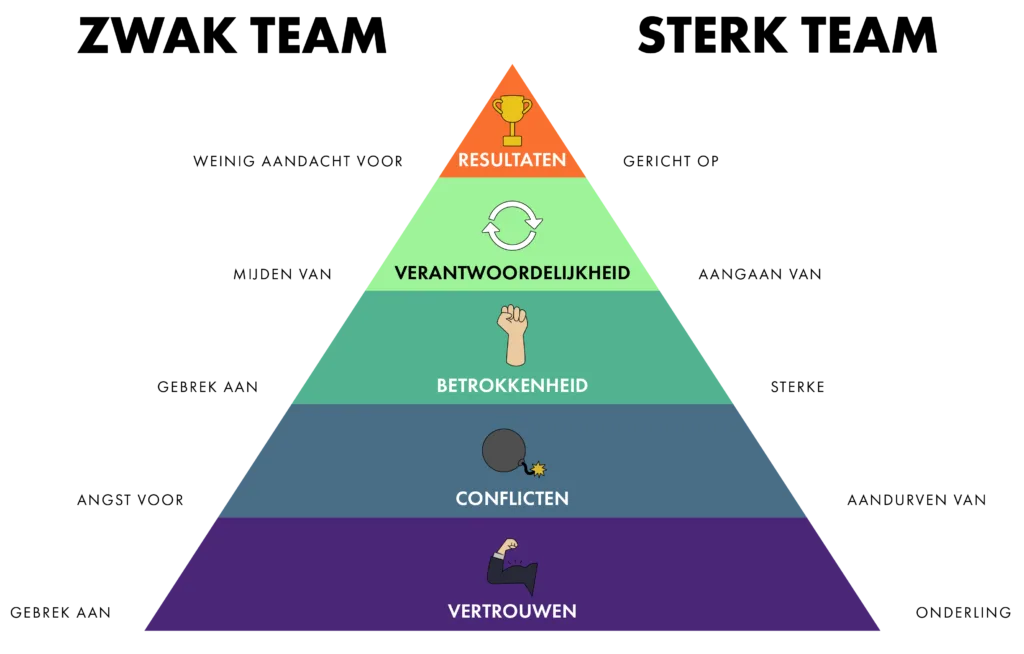
Building an effective and cohesive team is incredibly difficult. But it’s also actually quite simple … in fact, you don’t need great intellectual insights or tactics. It mainly comes down to courage, human qualities and discipline. From a clear mission, you can start working on the most important tasks and responsibilities in simplicity and rhythm.
Based on the motto: “we can learn from our mistakes but really develop based on our successes” we set to work in a 6-month program. This results in good performance and satisfaction of your employees and your customers.
The Team Pathway is ideally suited for: new (merged) teams, new tasks and roles, specially assembled (high performance) teams.
Enthusiasm, uncertainty
Frustrations, irritations, conflicts
Agreements, understanding each other
Trust, commitment
If a team is disbanded but also if the team composition changes drastically, a new leader arrives or people leave, a team may end up in this fifth phase.
To further develop your team, there are a number of key phases in team formation that can be recognized. These phases are commonly known as: Forming, Storming, Norming, Performing (and Adjourning). They depend on the extent to which the team develops maturity and competence, relationships are built, and the leadership style changes to more collaborative or shared leadership. Team effectiveness varies by phase.
Let's begin
Together we explore your team's strengths and dynamics; what do you value?
In imagining the ideal future, we ask each other the question: what do you desire?
Then we develop a program with success factors for developing your potential
We accomplish this with workshops that connect and can create positive change.


 Trustindex verifieert dat de oorspronkelijke bron van de recensie Google is.
 Trustindex verifieert dat de oorspronkelijke bron van de recensie Google is.
 Trustindex verifieert dat de oorspronkelijke bron van de recensie Google is.
 Trustindex verifieert dat de oorspronkelijke bron van de recensie Google is.
 Trustindex verifieert dat de oorspronkelijke bron van de recensie Google is.
 Trustindex verifieert dat de oorspronkelijke bron van de recensie Google is.
 Trustindex verifieert dat de oorspronkelijke bron van de recensie Google is.
 Trustindex verifieert dat de oorspronkelijke bron van de recensie Google is.
 Trustindex verifieert dat de oorspronkelijke bron van de recensie Google is.